• Dearest Nut : Our Cosmic Mother

    Goddess Nut and the creation of our world

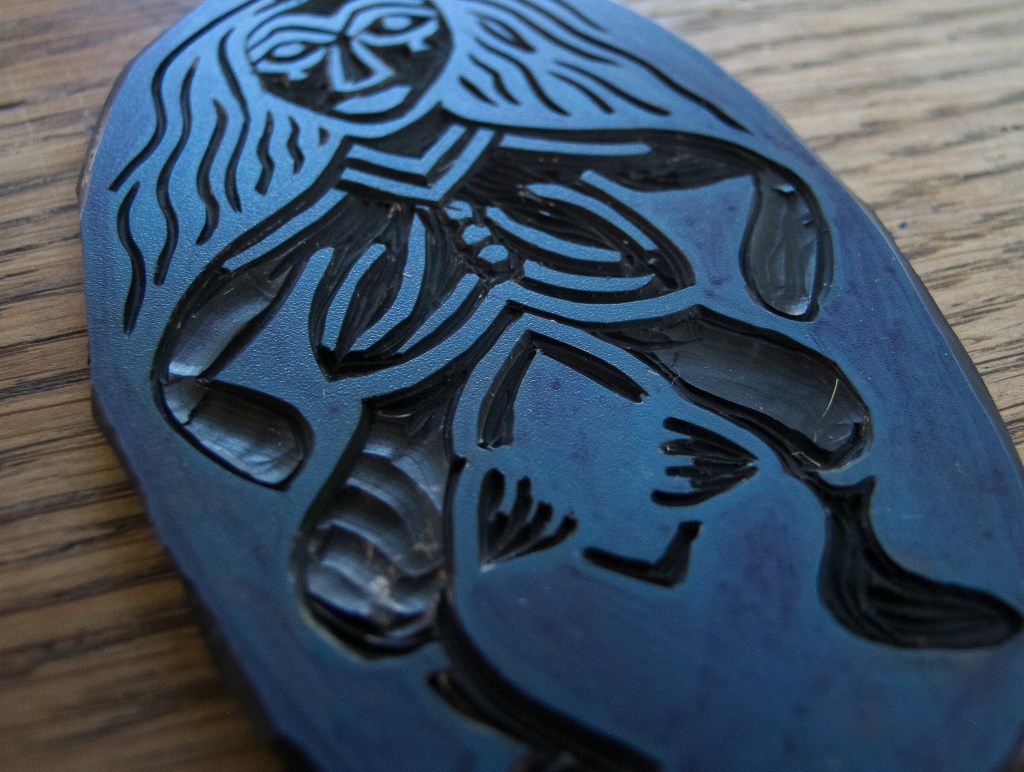
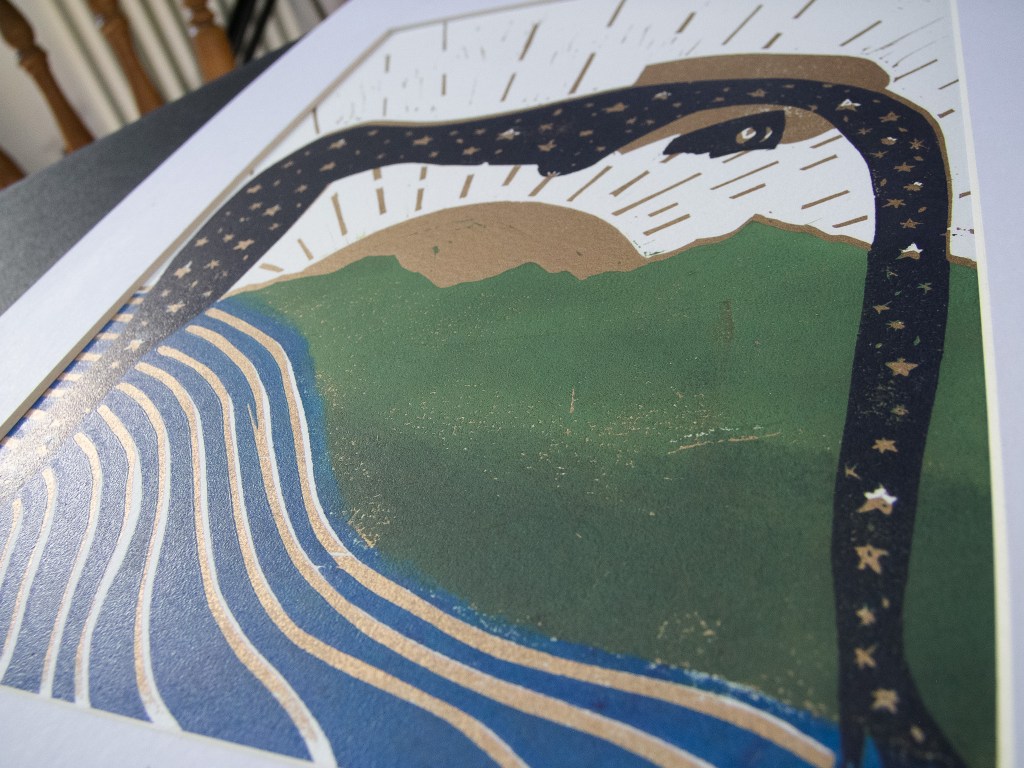
    Goddess Nut is one of the oldest Egyptian goddesses, and is a part of the Egyptian creation stories. Before time begin, Ra, the creator existed in the lifeless waters of chaos called the Nu. He rose from his inert state and created Shu, the air and Tefnut, the moisture. Together Shu and Tefnut gave birth to Nut, the sky and Geb, the Earth. Nut and Geb were deeply in love and embraced each other so closely that Ra got jealous and put Shu, the air in between the lovers. In this way, Nut forms a protective layer over the Earth, saving us from the watery chaos above. All the celestial beings move through her body. Even Ra the creator, who later became the Sun. Ra is swallowed up by Nut every night and every morning she gives birth to him, giving her the title Mother of Gods. She also gave birth to the last four of the Great Ennead- Osiris, Isis, Set and Nephthys. She certainly has a very important role in the Egyptian universe.

    The Attributes of Nut

    Goddess Nut of the Sky. mother of all. She has always been looked upon as a loving caring Goddess. She holds a space for us, away from the watery chaos outside. She birthed all the stars and the celestial beings and loves the Earth passionately, Although she was rarely worshipped in daily life, as the sky is simply the sky, once life ebbs toward death Nut becomes all important.

    O my Mother Nut, stretch Yourself over me, that I may be placed among the imperishable stars which are in You, and that I may not die.”

    This quote is from the ancient Egyptian Pyramid Texts, which are among the oldest known religious writings in the world, dating back to around 2400-2300 BCE.

    Goddess Nut, protector of the dead. Many inscriptions and carvings of Nut in Egyptian tombs such as the verse above have been uncovered. Nut was believed to carry the dead up to the sky with her and they would join her in her celestial world. She is a beautiful Goddess to call upon if you are grieving, her arms wrap the world in an all encompassing embrace. She protects the living and cares for the dead. She loves deeply and if you lie still and quiet and look up at the night sky it almost feels like you can feel her embrace.

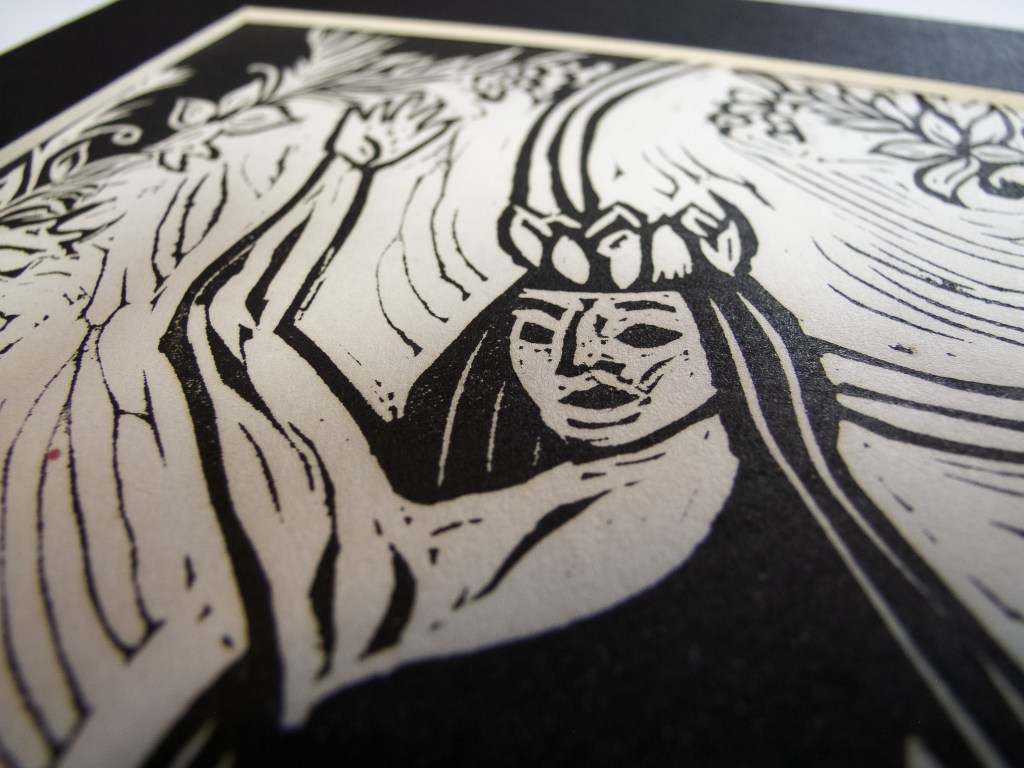
    I was commissioned to make my print of Goddess Nut for someone who had experienced an enormous loss and I hope that it gives some solace. As it is an reduction print, no more can be made but I think one day I will revisit her. She is most definitely worth getting to know more deeply.

    The linocut greeting card of Nut is available at The Coventina Press
  • Mother Earth : Gaia from Greek Mythology

    Gaia comes from ancient Greek stories, where she represented the Earth as a living being. The Greeks believed she was one of the first gods to appear when the world began.

    According to these ancient tales, Gaia emerged from Chaos, the first primordial goddess , who was the vast empty space that existed before everything else. Gaia arose from this nothingness and became the Earth itself.

    The Greeks saw Gaia as a mother figure who gave birth to many gods, goddesses, and Titans. She was considered the ultimate life-giver, caring for all living things on Earth. The stories tell us that Gaia loved her creation deeply and promised to protect it always.

    Mythologies from all around the world connect with this idea of Earth as a living, nurturing force. When we talk about “Mother Nature” today, we’re drawing on this ancient understanding.

    Similar earth goddesses appear in cultures worldwide:

    • Terra Mater in Roman mythology
    • Pachamama in Andean traditions
    • Prithvi in Hindu culture
    • Jörð in Norse mythology

    This universal concept suggests something deep in human nature recognizes Earth as more than just rock and soil. From towering mountains to delicate spring flowers, everything in nature was seen as part of Gaia’s creative energy. She wasn’t a distant goddess – she was present in every tree, rock, and blade of grass. The Earth itself was her body, and everything living on it was part of her being.

    This ancient wisdom found new life in the 1970s when scientist James Lovelock proposed the “Gaia hypothesis” – the idea that Earth functions as a single, self-regulating living system. Suddenly, ancient mythology and modern science were saying something remarkably similar: our planet is alive.

    Gaia Rebels

    Gaia’s most famous story involves her rebellion against her husband Uranus (the Sky). After giving birth to the Titans, Uranus feared and hated his children, keeping them imprisoned within Gaia’s womb. In response to this cruelty, Gaia made a plan to overthrow him by creating a sickle made of flint and giving it to her son Cronus. When Uranus came to lie with Gaia, Cronus castrated his father, allowing the Titans to rule. Later, when Cronus became ruler and began swallowing his own children to prevent them from overthrowing him (just as he had done to his father), Gaia again rebelled. This time she sided with her grandson Zeus in his rebellion against Cronus. Gaia rebelled against the reigns of all three rulers of the universe (Uranus, Cronus, Zeus), but ultimately had to accept Zeus as the supreme king.

    I am planning to do a post about all the different mother earth goddesses, actually planning to do a mother earth calendar for 2027, so ill be researching the various earth mother in the coming months.

    Gaia Artwork is available at The Coventina Press
  • Dearest Sheela,

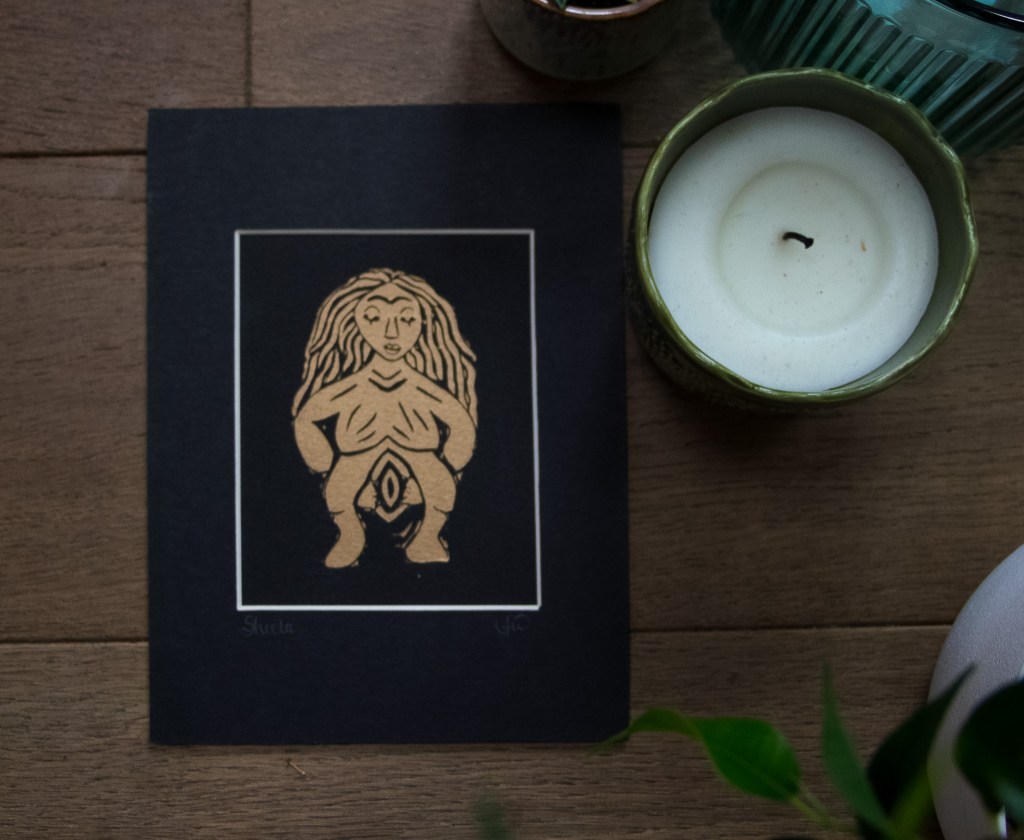
    I first saw an image of Sheela na Gig whilst doing my art A Level at 17. She fascinated me. Her grotesque form delighting in her own body. Her ugly crone like appearance seemingly at odds with the overt sexuality of her pose….What enticed me even more was that her symbology is a mystery. The reason for her existence and especially her connection with the Church is unknown.

    There are many goddess attributes that Sheela could take on, and throughout her long history I’m sure she has worn them all. Perhaps she truly is all them, the maiden, the mother, the crone. The triple goddess, in all her power, baring her teeth and her vagina to the world.

    Sheela Attributes

    A Fertility Symbol

    As a fertility goddess, she stands proud. She shows us our path through labour and she gives hope and representation to women all over the world. A powerful symbol of a woman’s ability to stretch and open, to give birth.

    I think what I love about her as a fertility goddess is the lack of beauty. This is no rosy, healthy, full of the life, ‘it will be all wonderful’ fertility goddess. This is a life and death, skin and bones, a give birth to the world and all that is in it whilst roaring your defiance fertility goddess. The rawness can be healing.

    Goddess of Sexuality

    Images of lust is an interesting book about research on a sexual carvings in religious settings in the UK, Ireland and mainland Europe. Sheela na Gig’s are of course a prominent feature. It is put forward in the book that the Sheela’s were carved by the church in the 11th/12th century as a warning against lust. Of all the explanations imagined about Sheela and her origins this one has the most research to back it up. I think that this could be true for a lot of the Sheela’s found displayed prominently on churches, and they can be rather grotesque. But some Sheela’s appear to be smiling and endearing in there strangeness, certainly not something to fear.

    As a goddess of sexuality, she has her place. She is certainly not Venus or Aphrodite, this isn’t about love and sensuality. However there is something to be said for a symbol that allows for overt sexuality in women. In a society that has demonised it for so long, maybe Sheela is who we need.Sheela Na Gig carving on a church

    The Protector Goddess

    Another interesting theory is that the Sheela’s carved above doorways and windows are actually talismans to keep out the devil and protect us from the evil spirits roaming the Earth. In many ancient cultures the female genitalia were believed to hold magick. That they could be used to cast spells for good or for bad. In Finland for example the vittu, which is specifically a mothers vagina would protect the home, the cattle and the children. A bare vittu shown to the forest would scare away the beasts. Perhaps that was their role in the churches of old. Perhaps back then the vagina was a symbol of power and magick, the divine womb protecting those that passed it. Unfortunately that time has passed and in the 17th century many Sheela’s were removed from the Churches as a old symbol that was inappropriate for a more modest age.

    A Pagan Goddess

    It is indeed unlikely that the Sheela’s come from a time before Christianity, but the belief that she is a remnant of when the world worshiped the Mother Goddess, and the society was matriarchal is still the most widely accepted meaning. She does bare remarkable similarities to the ancient Greek goddess Baubo. Baubo is generally plump and sits legs apart showing her vulva. Some believe that the idea of Baubo stems from even older goddess religions from around the world. There are many examples of statues and art from ancient times when the vulva was not obscene and often worshipped for its life giving ability. It was even viewed in many places as a portal to the supernatural and it held a power unparalleled.

    My personal belief, she is the Great Mother, A representation of the cycle of life. Her open vagina pulled apart giving birth to all of existence whilst simultaneously her crone like appearance showing us that death is the other side. Never one without the other. Maiden, Mother. Crone.

    Regardless of when, or how or why these carvings exist, they hold immense power in today’s world. Whether you view her as the Great Mother, as a fertility goddess, as a protector or simply as a whore. Sheela has become part of our modern mythology, and there are many lessons to learn simply by looking at her closely.

    Sheela Na Gig Linocut available in the shop listed below!

    Sheela Na Gig linocut and Sheela Linocut Large

    Sheela Na Gig greeting card

  • Ancient faery queen of Britain

    The Queen of Elphame is an ancient fairy queen renown on the border of England and Scotland. There are many an old folktale in the British Isles describing a woman by the side of the road. Sometimes she is a fine white lady upon a horse or desperately beautiful seductress, and sometimes she is a decrepit old lady in need of help. However she appears to the traveler, she is there for one reason alone, and that is to whisk the human off to the realm of the fairies. One of the most well known tales of the Queen of Elphame is of Thomas Rhymer.

    ‘I’m not the Queen of Heaven, Thomas,
    That name does not belong to me;
    I am but the Queen of fair Elphame
    Come out to hunt in my follie.

    Thomas Rhymer by Robert Graves

    The tale of Thomas Rhymer

    Thomas the Rhymer, lived in the 13th Century and was a Scottish laird. This much we know for fact. The story goes that one day Thomas fell asleep under the Eildon tree. When he awoke, his eyes fell upon a beautiful lady dressed in green riding a white horse. She leaned down to him and kissed him. He was enchanted by her beauty and followed her to the elven realm. He spent seven years in the Land of the Elves and came back a changed man. He had the power of prophecy and was gifted with awen – poetic inspiration. And then after seven years he disappeared once again. This historical man, and the stories of his powers became the starting point for many similar tales all across the country, such as the story of Tam Lin. The Queen of Elphame appeared in them all. Sometimes she was a kind and good elven queen and sometimes she was malevolent. Perhaps has with most fairies, she was both these things.

    Another interesting fact regarding the Queen of Elphame is that she was mentioned throughout the Scottish witch trials. She was described has a devil type figure who would lead the women astray and cause them to do all kinds of evil things. She was not only the Queen of the fairy realm it seems but also the queen of the witches.

    The Queen of Elphame, hand printed original linocut is available to buy here and also a greeting card

    Back with more goddesses soon, bye!

  • Dearest Cerridwen : Goddess, white witch, enchantress. She has been called all of them.

    Let us begin with the Mythology. The story of Cerridwen and Talesin the Bard. This is a story of a mother love, an enchantress’ wrath and the death and rebirth of a hero.

    Cerridwen had two children, her daughter was beautiful and full of light and her son Morfran was hideous and dull witted. Cerridwen was worried for her son, believing he would not be accepted in to high society the way that he was, so she decided to use her cauldron to help him. She set about brewing him the potion of Awen – poetic wisdom, inspiration and knowledge.

    The potion she would brew would take a full year to make and so set her servant Morda to stoke the fire and his apprentice Gwion to stir the brew whilst she gathered herbs. On the final day Gwion stirred the potion a little too hard and 3 drops of potion flew from the cauldron and landed on the boys hand. Without thinking the boy popped his thumb in his mouth to quell the burning and in that moment all the knowledge of the world flew through him. He realised the wrath he would face from Cerridwen for having stolen her son’s future and so he ran. When Cerridwen returned she was furious and so the imfamous chase began.

    Gwion Bach with his new powers transformed himself into a hare and ran like the wind. Cerridwen seeing this transformed in to a greyhound and pursued swiftly, Gwion ran to the river, diving in he shapeshifted into a fish but Cerridwenn close behind became an otter to out swim him. Gwion then shifting into a bird flew into the sky but Cerridwen leapt out of the river and transformed into a hawk chasing him down. Closer now, Gwion began to panic, when he saw a barn of wheat. He quickly transformed into one of many grains of wheat believing he could hide. Cerridwen saw what he had done and shapeshifted in a hen, she scratched through the grains until she found him and swallowed him up.

    Now this seed inside of Cerridwen grew and she soon realised that Gwion was to be reborn through her as her son. When she held him in her arms nine months later, her anger had dissipated but she could not keep the child, beautiful though he was. She decided to cast him out and let the fates decide if he should live. She wrapped him in a leather bag, and with a pray and a blessing through him to the sea. And so begins the story of all great heros. Gwion once rescued became talesin and the tales regarding his intelligence and foresight and his beautiful poetry are legendary.

    Cerridwen’s Attributes

    Inspiration

    As mentioned in the above story, one of Cerridwen many names is the Keeper of Cauldron. She used this cauldron for good, to help others and to provide answers. The timing of her story is placed around the Arthurian legends and often the Cauldron of Awen and Holy Grail are surmised to be one and the same. Awen is a welsh word for ‘inspiration, especially creative inspiration, poetic wisdom and when personified Awen is the muse. So as the Keeper of this cauldron, Cerridwen is a powerful source of guidance in all things creative and can be called upon to help you find your creative inspiration.

    Transformation

    Another of Cerridwen’s gifts is of transformation. She is a shapeshifter and a powerful enchantress and has the ability to help others change. In the story above we see her change Gwion life dramatically, from a servant to the most famous bard in all the land. The fire of transformation may be difficult but rebirths always are. If you get stuck and lost Cerridwen is certainly a goddess who can aid you in finding your new path.

    Rebirth and the cycle of life and death.

    One of the most important themes Cerridwen’s story gives us is that of life and death. Everything in our life is in a cycle, things go and come around again, changed and transformed. The chase represents the changing seasons around us and also the need for change in ourselves. Something must die for it to be reborn. Gwion died and was reborn as Talesin. Cerridwen herself transformed from vengeful sorceress to a mother at peace with her fate. They both suffered but came out the other side with true knowledge and inspiration.

    Cerridwen oracle card

    CERRIDWEN
    The great goddess Cerridwen was an enchantress, sorceress and witch. She was the sacred keeper of the Cauldron of Awen.
    Awen is the welsh word for creative inspiration and poetic wisdom. With her powerful magic she possessed the power of prophesy, transfiguration and spell working.
    Cerridwen is the great mother goddess of change, of life and death and rebirth. She is the goddess of memory and time and magick.
    Call to Cerridwen when you are stuck, stagnant and feel the need to move on and transform but don’t know where to start.
    Like the changing of the seasons everything around us comes and goes. Change is essential.
    Call to Cerridwen to seek the knowledge and inspiration needed for your rebirth and she will show you the way forward.

    The Coventina Press

    All artwork is available over at The Coventina Press
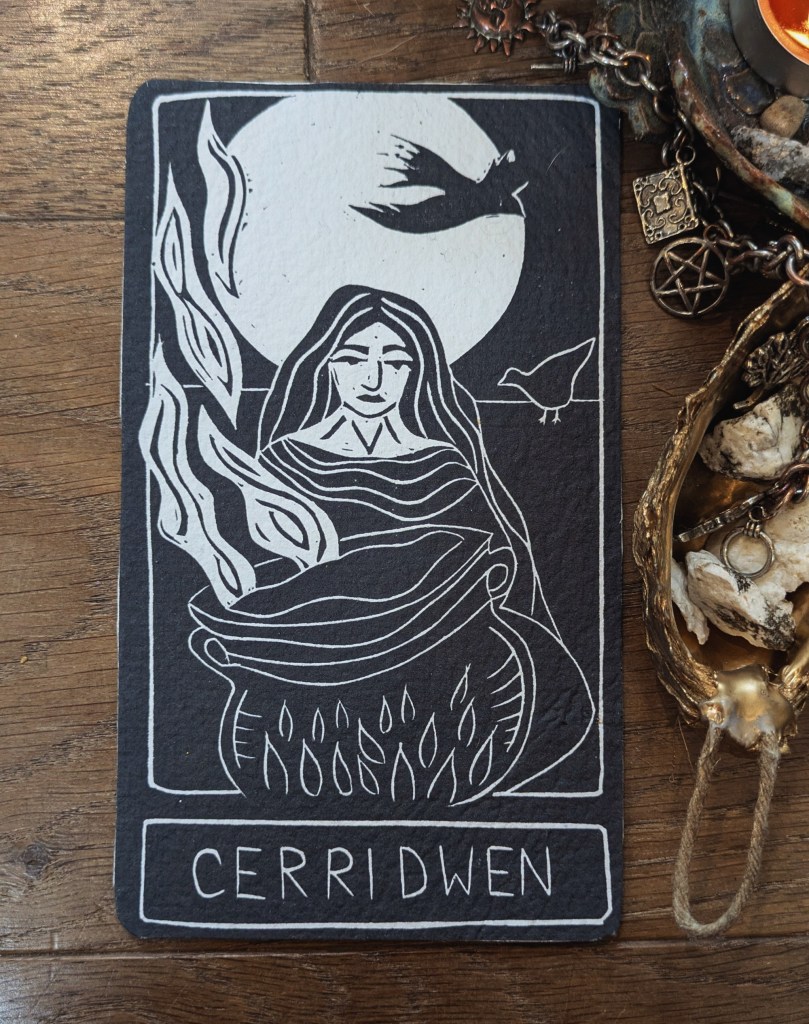
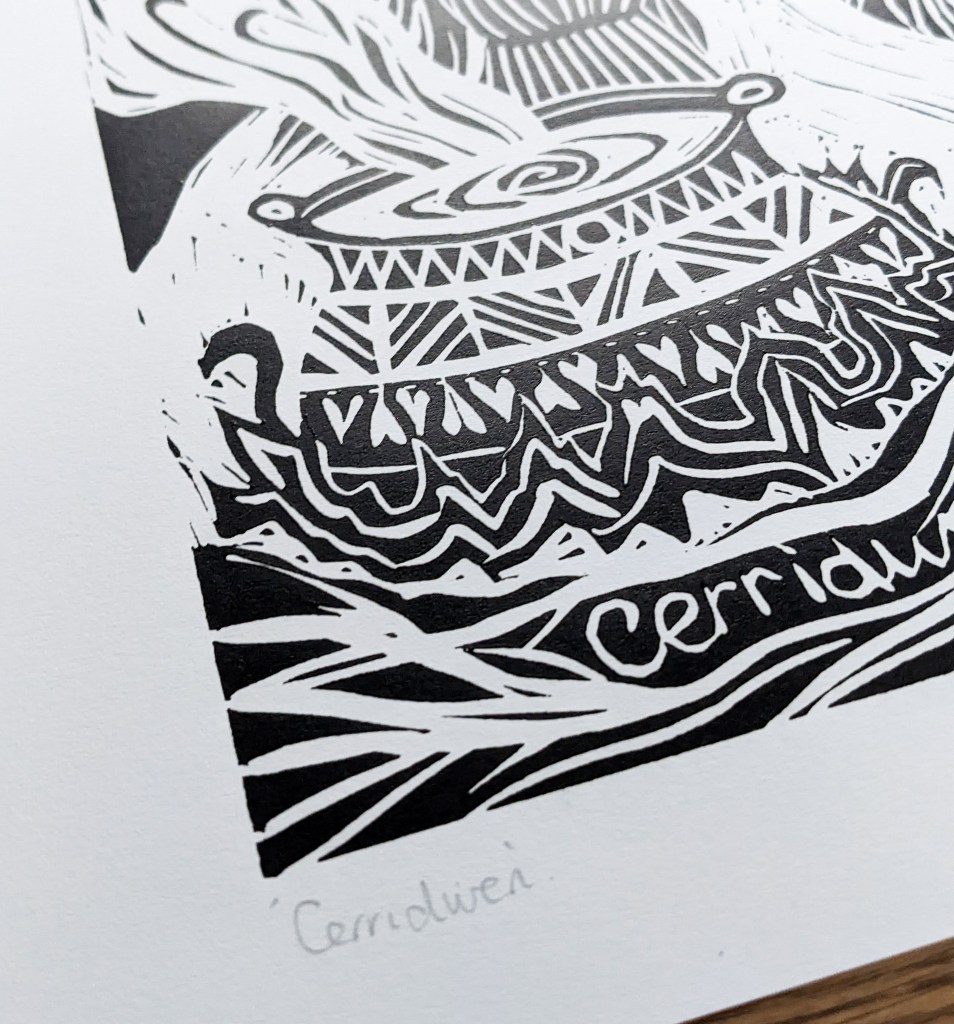
    Cerridwen linocut print and greeting card

    Cerridwen Oracle card

    Cerridwen Miniature eraser print

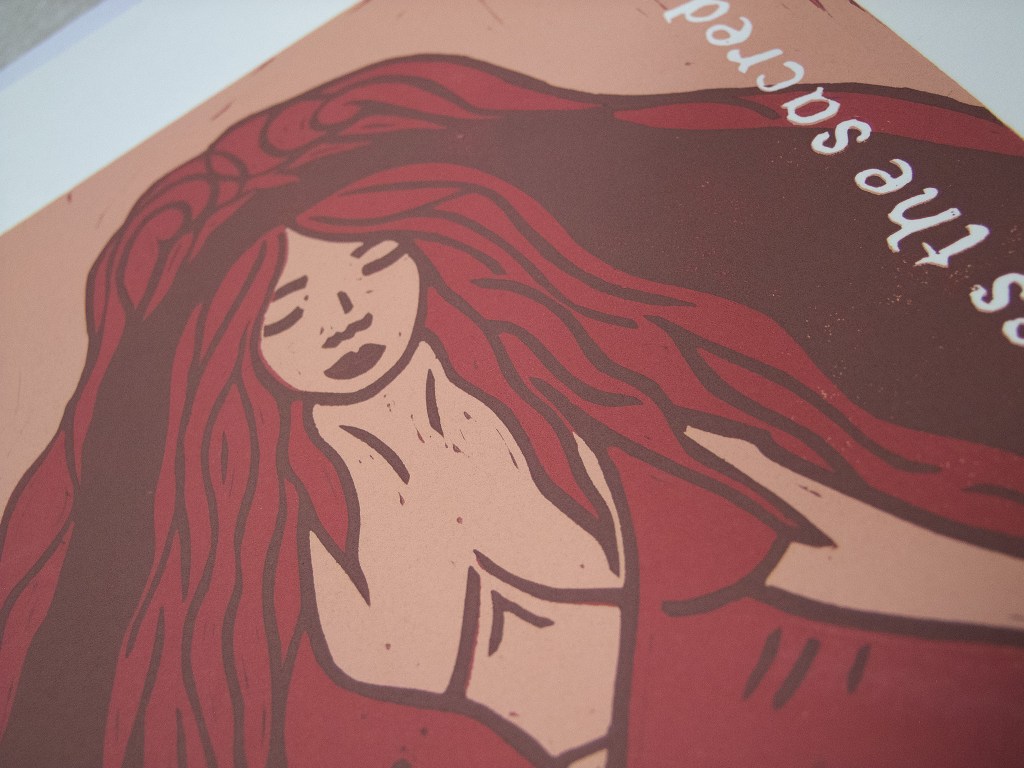
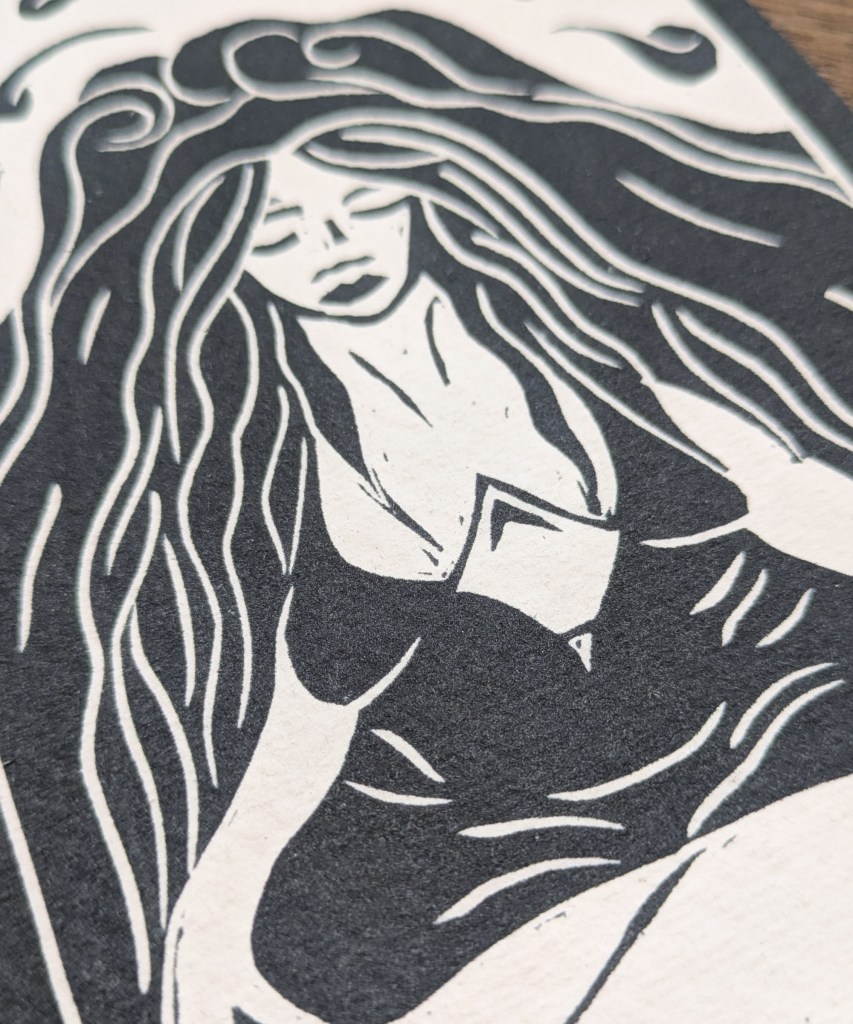
  • Pele: The Fiery Goddess of Hawaiian Mythology

    Dearest Pele,

    Wild fiery daughter of Haumea, Mother of the Earth and Wakea, Father of the Sky. Pele is a most beloved Hawaiian deity. The legends of her are vast and would be impossible to capture in such a short post as this one. So I will tell just one story. A story of passion and pain.

    Pele and Lohiau

    Pele, goddess of volcanoes, fire and lightning was sent away from her home. She set off for an adventure in a canoe, carrying with her, her little sister, Hi’iaka in the shape of an egg. The ocean was so vast and the journey so long that when they finally arrived at the islands of Hawaii her little sister was already grown. Pele made the volcanoes and her sister danced among the flowers and groves and they were happy. Pele often traveled in spirit form to the many islands of Hawaii and on one visit met a mortal man called Lohiau and fell deeply in love with him. She spent as long as she could with him but eventually needed to return to her body and missing him desperately she begged her sister to travel to him and bring him to her. Pele, aware of her sisters beauty made her sister promise not to fall in love with him and to return within 40 days. Hi’iaka in return asked only that she care for her friend Hopoe and her groves.

    Hi’iaka’s journey to find Lohiau was a difficult one. Winds and rains lashed at her canoe and the journey took many weeks. When she finally arrived at the island, she found that Lohiau had died of a broken heart. Using all of her power Hi’iaka brought Lohiau back from death and asked if he would travel with her to Pele and he agreed. As they approached Hi’iaka realised that she had taken too long and 40 days had been and gone.

    Pele all alone on the island had begun to rage, she believed her sister had betrayed her and had kept Lohiau for herself and in her fury she exploded with Lava. It flowed down through the beautiful groves, killing everything in its path, including Hi’iaka’s best friend. Hi’iaka on her approach saw what Pele had done and sobbed in pain. Lohiau wrapped his arms around her to comfort her and Pele saw the pair and knew she had been forsaken. She sent all her might against the little boat, swirling it in the sea, surrounding it in a towering inferno but little Hi’iaka fought against her and the pair escaped to a different island. Eventually Lohiua and Hi’aka did fall in love and they spread their love of flowers and dance to all the islands in the tradition of Hula. Goddess Pele, passionate and impatient, stayed in her volcano, erupting every so often to remind the world of her power and her pain.

    This is just one story of Pele and just one aspect of her personality but it is a great story to describe the element of fire and the fire archetypes within us. Passion is a powerful thing but a fire that burns too bright will consume you, and quite possibly everything you love as well.

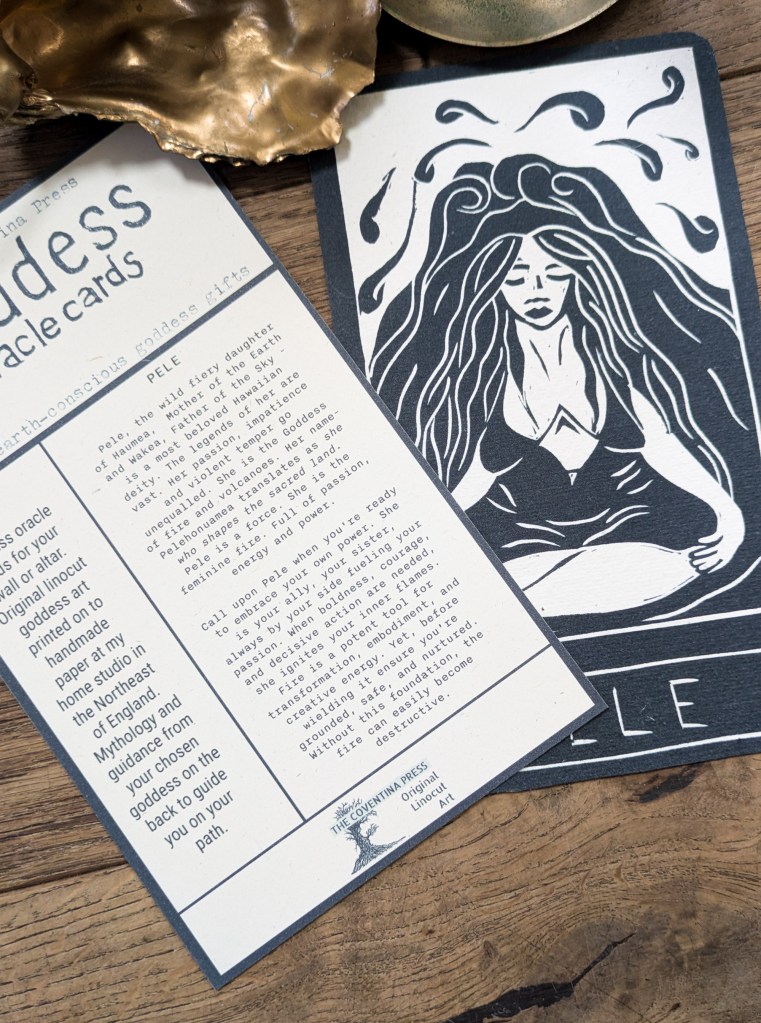
    Pele oracle card

    Find Goddess Pele art over at The Coventina Press.

    Pele Linocut

    Pele greeting card

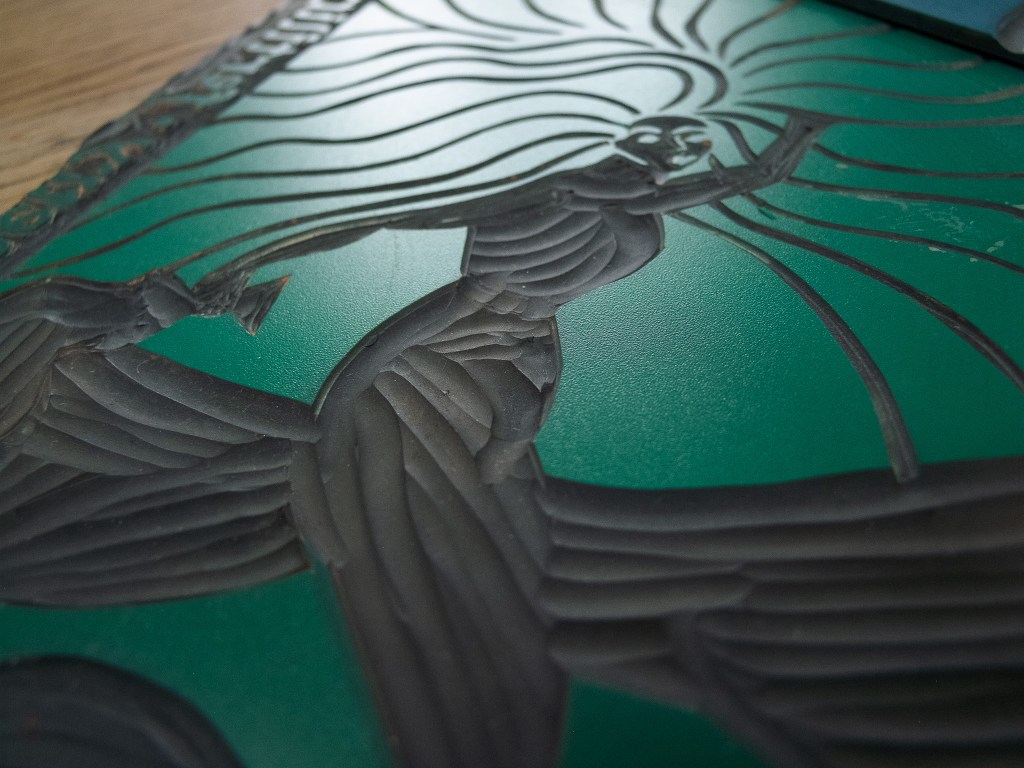
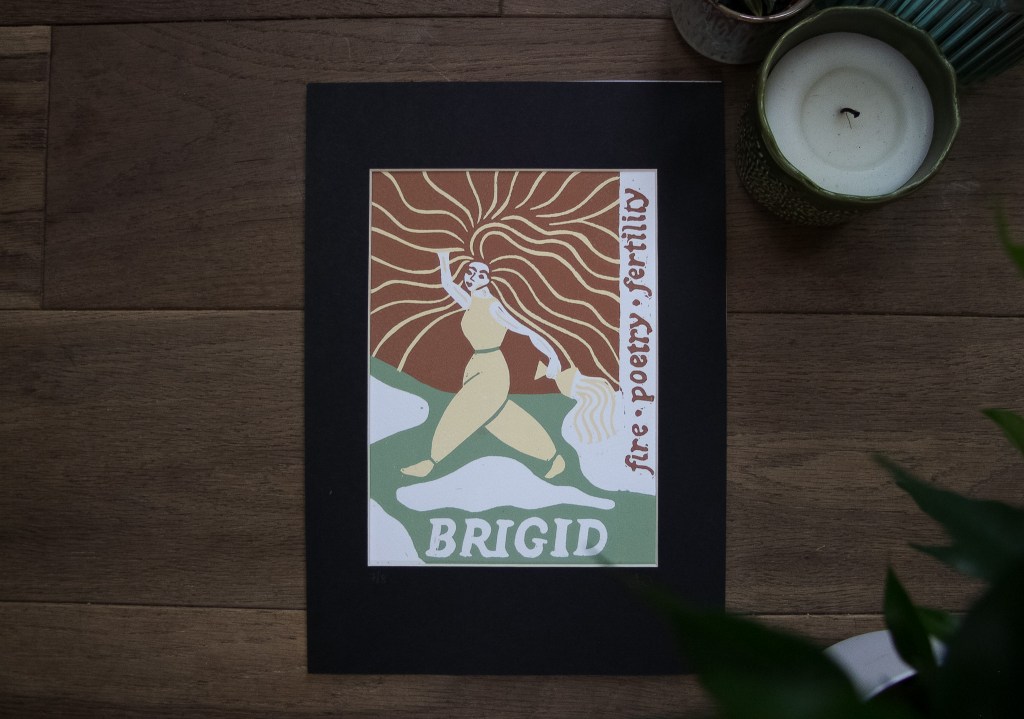
  • Brigid: Protectress of Justice and Inspiration

    Dearest Brigid, who can be summoned with many names. Brighid, Bride, Bridey, Brigit, Brigantia or even Saint Brigid of Kildare. Goddess of fire and flame, possibly the most powerful and well known of all the Celtic pantheon. Her mythology takes many paths and over the centuries has changed as different stories become enmeshed with each other. Her many faces through time are often contradictory but show a fascinating web of connectedness.

    Attributes of Goddess Brigid

    Brigid is associated with the element of fire, in all its aspects and glory. The many facets of this element and how it interacts in our inner and outer worlds.

    As the Goddess of inspiration she is the fire inside of us all. Our inspiration, poetry and vital energy; the force that moves us forward towards our goals. Our inspired wisdom and skill, all stem from this fire within, and Brigid is the goddess who tends it.

    As the Goddess of smith-craft and healing , she gives the ability to mold fire and bend the element to our will.

    Smith-craft as always been associated with magick and the supernatural, and blacksmiths were held in high regard throughout the Celtic world as were the healers and their skill and ability to save those around them.

    As Goddess of the forge, she oversees justice, law and order, and the attribution of punishment. She protects the rights of women and upholds the peace as a warrior with her fiery arrow and offers strength and protection to any who fight for justice.

    But perhaps the most important aspect and certainly the most well known is of Brigid who brings the Sun.

    Brigid and the festival of Imbolc

    The festival of Imbolc has been celebrated for centuries. It was especially important in the budding agricultural world of the Celts; where a long winter could mean death and starvation. Imbolc is celebrated on the first days of February, half way between the winter solstice and the spring equinox. The animals would begin to calve and the mothers milk would begin to flow. As the Crone releases her grip on the Earth, the plants would begin to grow once more. The celebration of life returning and of Spring on its way is the celebration of Brigid; as the maiden arriving and as the great mother welcoming it in.

    This festival day is still celebrated throughout the Celtic world today and is also celebrated as Candlemas in the Christian world. Our Goddess Brigid became St Brigid of Kildare, patroness of Ireland and the Mother of Saints. A fire was kept burning in her honour for hundreds of years at her convent in Kildare.

    Whichever way you choose to honour her; as Goddess or Saint, Brigid is the fire that burns within us, the fire in our hearths and the fiery sun in the sky. She will forever bring you light and warmth on your journey if you but let her in,

    The Brigid limited edition linocut is available to buy here and as a greeting card here

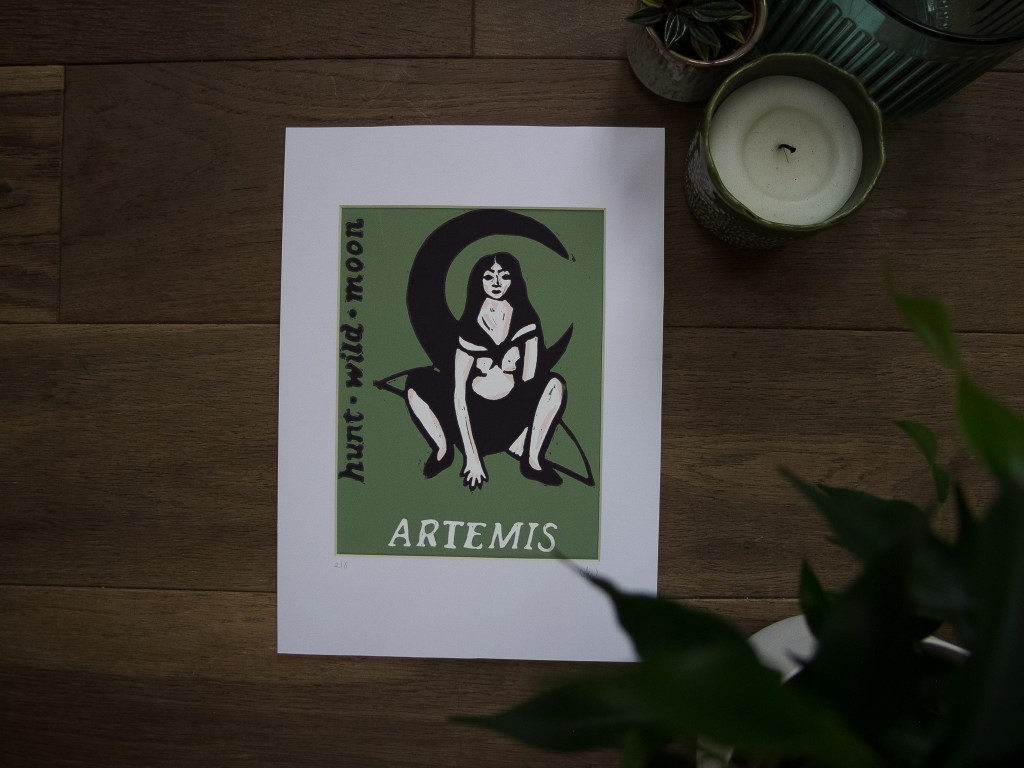
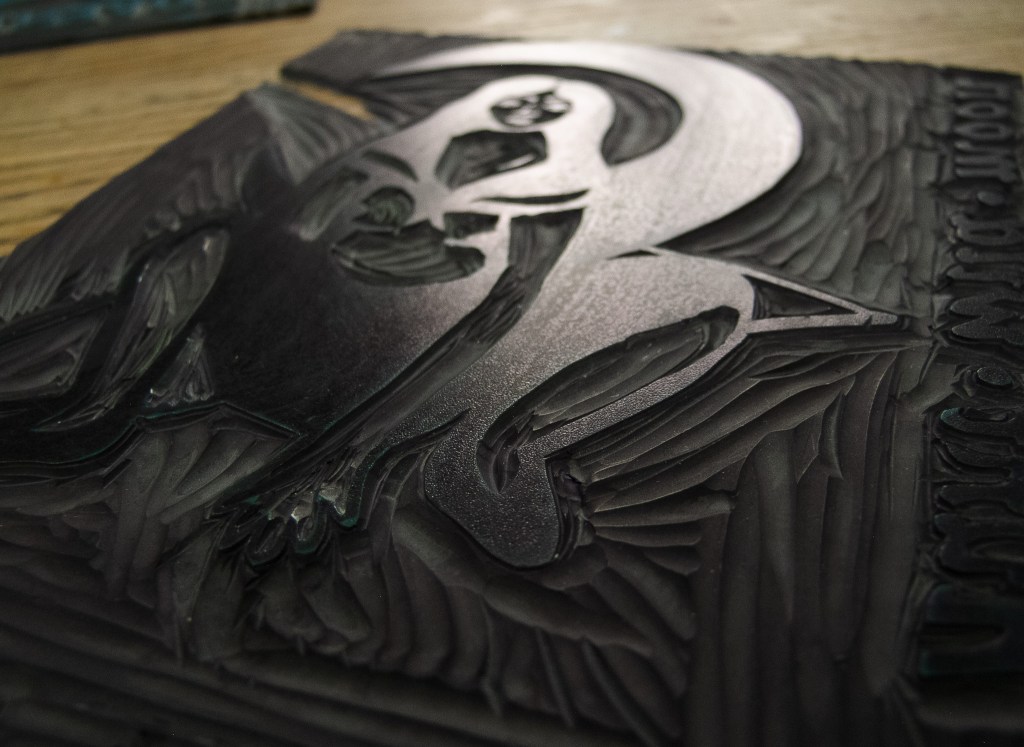
  • Artemis: The Fierce Goddess of Independence and Strength

    Dearest Artemis, steadfast and strong, intelligent and brave, fierce and loyal.

    Goddess of Childbirth

    Artemis’ mother Leto struggled to give birth to her twins because of Hera. In a jealous rage Hera refused to let her daughter, the then goddess of childbirth help Leto. She had made it impossible for Leto to find a safe space to have children. Artemis was eventually born first after much struggle and then helped her mother to give birth to her twin Apollo, taking the new mantle of Goddess of childbirth and midwifery.

    Goddess of Wilderness

    Artemis felt most at home in the wild, roaming the mountains and forests and being at peace with the animals that lived there. She never tried to harness or use nature for any purpose. She protected the wild and the animals from the outside world. Her and her companions would bath in the rivers and rest in peace from the hostility of the world around them.

    Goddess of the Hunt

    Artemis’ aim was always true. Her ability, skill and determination was legendary.

    Her fierce and loyal nature often brought her into confrontations with others who she felt had wronged her, her companions or her home and she never flickered in her attribution of punishment. She was ferocious in her revenge.

    Goddess of the Moon

    Often associated with the crescent or new moon. She illuminates the path for others, she will bring light in to your world and lead you through your hardest moments.

    Learning from Artemis

    At the tender age of 3, Artemis asked Zeus for 6 wishes. which he granted.

    -to be live without marriage or love

    -a bow and arrow

    -a hunting costume and the freedom from women’s clothes

    -the job of bringing light into the world

    -60 companions for her hunt

    -and all the mountains on Earth to live on,

    These requests gave her freedom to be her authentic self and to live the life she craved. It was this authenticity that made her the feminist icon she is today. She fully accepted herself, never let anyone keep her down and she always protected those around her.

    As a human assigned female at birth, I was conditioned to always put others first, to not stand up for myself, to not be too loud, or too fierce, or too strong.

    I’m fighting it now, I’m searching for my authentic self and I picture Artemis, in her defiance, in her total independence and her confidence and I see her walk besides me with her bow and arrow and her light. She is my companion and she always has my back.

    Available Artemis designs in my shop are linked below!

    Artemis Linocut print and greeting card

    Back with my goddess posts soon, bye!

  • Coventina : The Forgotten Water Goddess of Hadrian’s Wall

    Dearest Coventina,

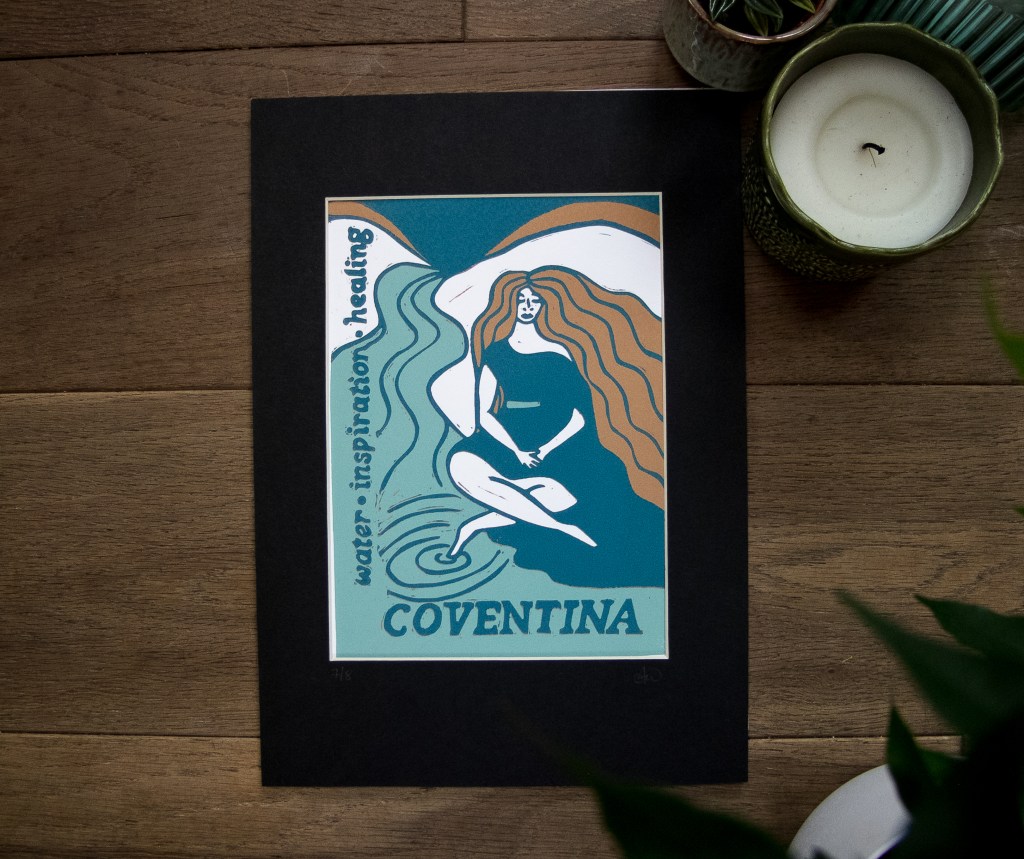
    Goddess of wells and springs. Queen of the river deities. First worshipped in Celtic Britain, when the belief in local water goddesses was strong. When people would bring gifts to the springs and wells to express their gratitude and to pray to the river goddesses for the clean, fresh life giving water to continue to flow.

    Once the Romans arrived in Britain, Coventina of the Wall continued to be worshipped and was given a high status. Her name often inscribed with the words Augusta or Sancta. At Carrawburgh in Northumberland she was given an altar at the well and many coins, vessels and other votives to her were found there.

    Attributes

    Her gifts are of abundance, inspiration and healing. She is often pictured as a water nymph figure lying down next to a spring, pouring water from a cup, with a large leaf next to her. Some artwork from the Roman era shows in triptique form, as a three aspect goddess. Sadly there are no stories of Coventina, no myths that have lasted through time, but she remains as a memory, an ancestral wisdom of the importance of our natural waterways in Britain.

    On a more personal note, Coventina is the Goddess that guides me on my artistic journey. She is reason The Coventina Press exists.

    If I ever feel stuck or lost, she arrives at my side. Her well is a lost place now, hidden in a field of reeds. No sign everyone worshipped her so deeply. But if you make the pilgrimage to her home in the summer months you may be lucky enough to see her presence, to feel her in the yellow flowers that guide you to the once sacred place, to sit in that wilderness and watch the trickle of beautiful clean water still coming from the ground. She is still there, and we still have so much to thank her for.

    The limited edition Coventina Blue hand printed linocut is available to buy here and as a greeting card here. The Coventina Black hand printed linocut is available to buy here and as a greeting card here

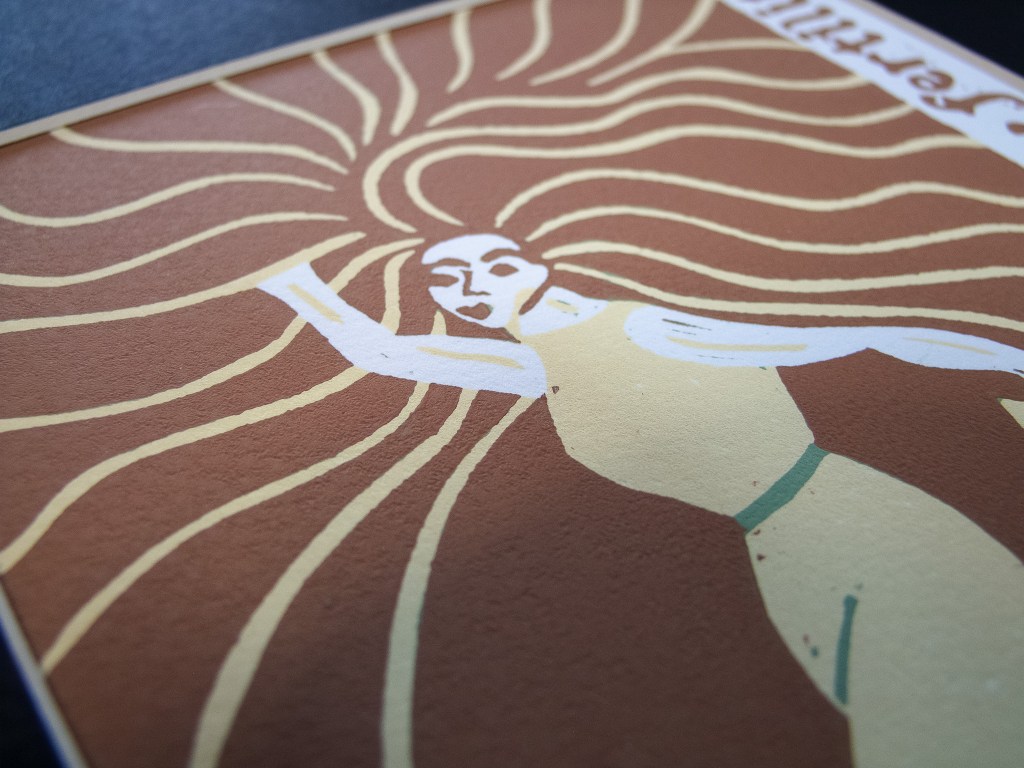
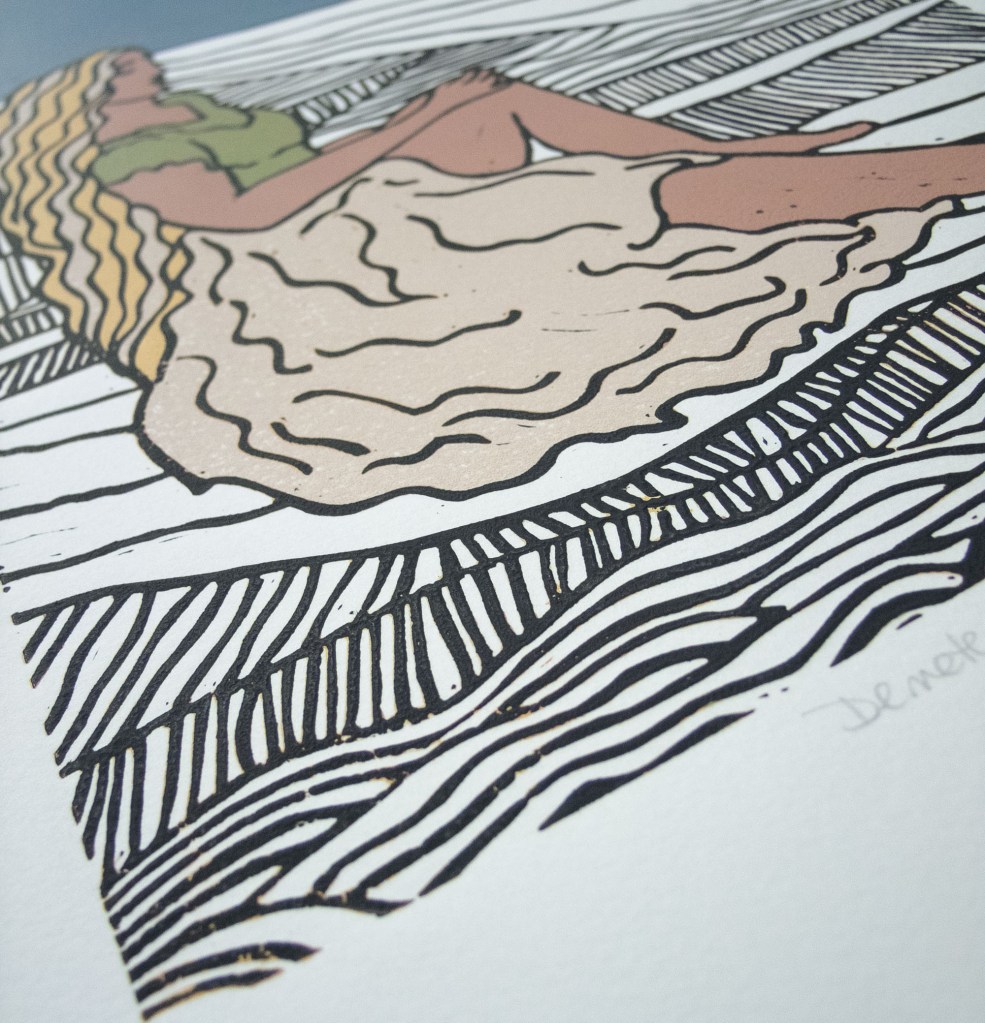
  • Greek Goddess of Harvest, Agriculture and the Seasons
    Dearest Demeter. One of the Twelve Olympians. She is a very important Greek Goddess and there are many myths that surround her. She is the goddess of grain, agriculture and harvest and the fertility of the Earth, but it is as her role as a maternal goddess that we learn the most. The Myth of Demeter and Persephone is a well known tale of a Mothers grief and is also a creation myth of the seasons.

    The Story of Demeter

    Demeter was the third born child of Kronos and saw swallowed by her Father and saved by the youngest son, Zeus. She became the Goddess of Agriculture and taught humans how to harvest and look after the land and learn agricultural skills to never go hungry. She was a kind, maternal, nurturing goddess who loved humankind.

    Demeter had a daughter with her brother Zeus, named Persephone and they were extremely close. Persephone was the Goddess of Springtime and was worshiped alongside her mother as an agricultural goddess. One day she out collecting flowers in the meadows when she disappeared. Demeter searched the world for her and could not find her anywhere. She was completely distraught and the world around her became to die. Demeter has stopped caring for the outside world and in her sorrow the plants, the harvest began to suffer. Unbeknownst to Demeter, the other Gods knew where Persephone was. Hades, God of the underworld had asked Zeus for Persephone had in marriage and Zeus had agreed. Eventually Helios and Hecate took pity on Demeter and told her what Zeus had done. She was aghast and the world around feel into a deep cold winter.

    Zeus, began to fear for the human race and asked Demeter to stop her affect on the land but Demeter refused and told Zeus if he did not return her daughter, the cold famine would continue. Zeus had no choice but to try and get Persephone back! Hades relented for the sake of humankind and Persephone was released from the Underworld. However before she left, Hades give her a gift of a pomegranate. Now it was common knowledge that if you eat whilst in the land of the dead you could not leave. The question of whether Persephone knew this and choose to eat a third of the pomegranate or whether it was a trick will never be answered. Persephone returned to the land of the living but as she had eaten a third of the pomegranate she had to leave for a third of the year and this is where we get the cycle of the seasons. The cycle of grief and acceptance, of happiness and sorrow.

    Winter alone Demeter lets the world around her die. Spring arrives with hope and Persephone once again walks the earth beside her mother and the world blooms. Eventually the time of her return to the land of the dead approaches and as Demeter begins to grieve the leaves fall from the trees until Persephone once more as gone to back to Hades. I choose to believe Persephone knew what she was doing and wanted both worlds. Her mother and her new home independent of her.

    Demeter and Persephone

    This myth was an important one for the women of ancient Greece as they often had no choice on their daughters husband and would have understood Demeter grief and her rage.

    Demeter is a loving, caring nurturing goddess.She is generous, helpful and you feel the warmth of her emotional and physical support whenever you need it. Her maternal persistence will make her stand up for her child regardless of the consequences, and her perseverance can change the mind of even the most powerful man.

    One last point to make, is that Demeter lived for and through her Daughter. Another way to look at this myth is through a lens of ‘leaving the nest’ What if Persephone wanted to leave? and Demeter through her own grief could not imagine her life without her daughter and therefore left no space for her daughter to grow. Persephone may have wanted to marry and travel to the underworld and live her own life. Sadly in the end she had no choice but to divide her life in two instead of sharing her life with both her mother and her husband. This is of course a different take on the same myth and either could be true.

    For more Goddess posts please check out the Directory, I’m working hard on it. I now have an information post for most of my linocut prints. You can shop for my hand printed Demeter linocuts here, greeting cards here.